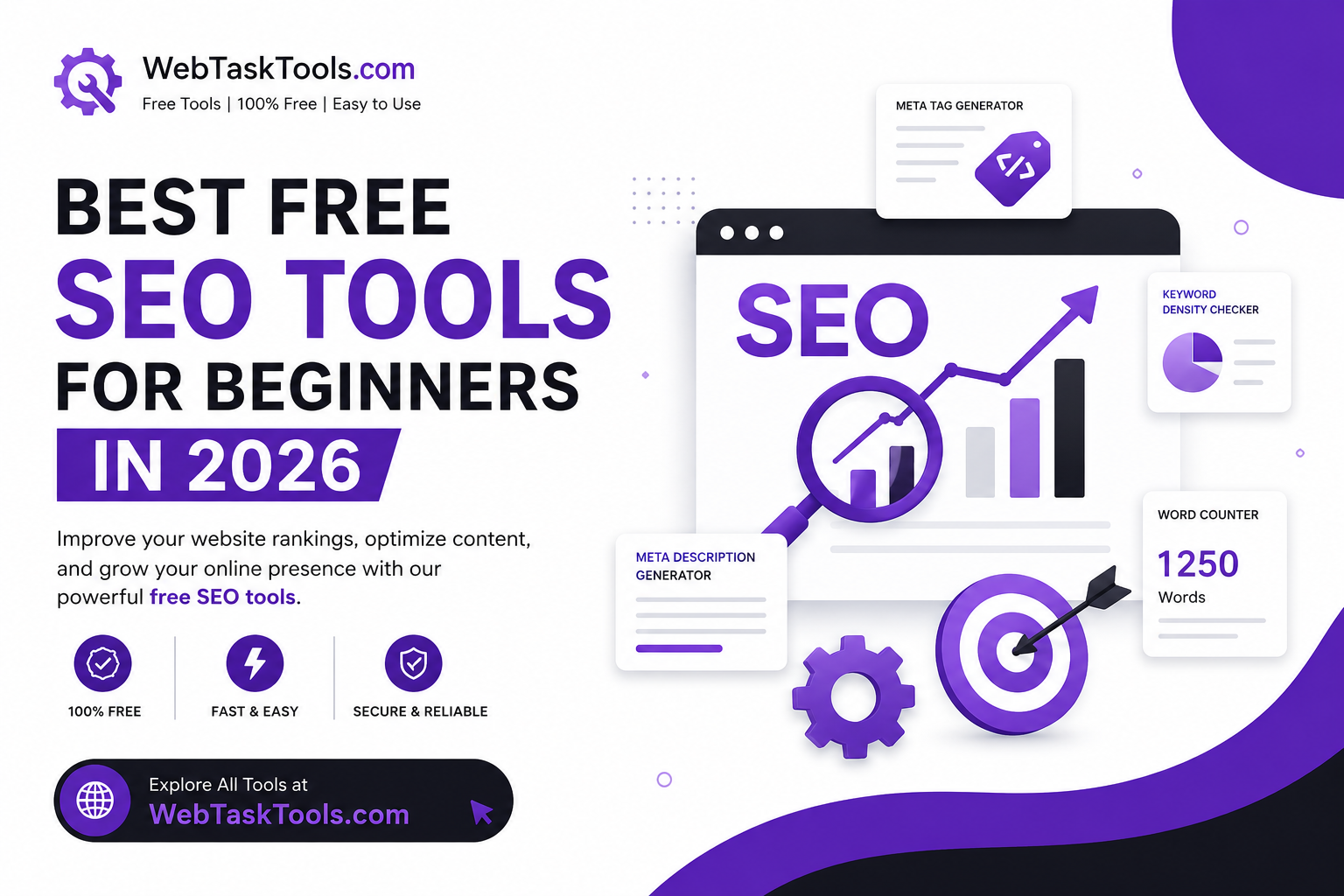
Looking for free SEO tools? Discover the best SEO tools for beginners in 2026, including keyword density checkers, meta tag generators, word counters, and more at WebTaskTools.
At WebTaskTools.com, you'll find a collection of free SEO and productivity tools that work directly in your browser—no downloads or subscriptions required.
Your first hands-on step: run any page through the free keyword density checker to see what search engines see in your words.
Why Beginners Should Use Free SEO Tools
SEO can seem complicated, but using the right tools makes it much easier. Free SEO tools help you:
- Optimize your website content
- Improve on-page SEO
- Create search-engine-friendly titles and descriptions
- Analyze keywords
- Save time on repetitive SEO tasks
- Increase your chances of ranking on Google
Essential Free SEO Tools Every Beginner Needs
1. Meta Title Generator
A compelling meta title improves your click-through rate from search results. Use a title that includes your primary keyword and stays within Google's recommended length.
A meta description generator writes your page summaries and shows their length as you type. In practice, the same job is done well by drafting in any editor and checking length with the Character Counter — descriptions display best when kept concise (roughly 150-160 characters), and the Meta Tags Checker shows you how the finished result looks to a crawler. Write for the human scanning the results page: a clear promise of what the page delivers, in plain language.
A well-written meta description encourages users to click your page. Generate SEO-friendly descriptions that summarize your content naturally.
3. Word Counter
High-quality content is one of Google's top ranking factors. A word counter helps you monitor article length and maintain consistency.
4. Character Counter
Keep your SEO titles and meta descriptions within the recommended character limits to avoid truncation in search results.
5. Keyword Density Checker
Avoid keyword stuffing while ensuring your target keyword appears naturally throughout your content.
6. URL Encoder & Decoder
Useful for developers and marketers when working with URLs containing special characters.
7. JSON Formatter
Developers can quickly validate and format JSON data used in structured data and APIs.
Why Choose WebTaskTools.com?
Unlike many websites that require registration or paid subscriptions, WebTaskTools.com provides fast, browser-based tools that are free to use.
Benefits include:
- Free
- No software installation
- Mobile-friendly
- Fast processing
- Easy-to-use interface
- Regularly updated tools
Explore More Free Tools
In addition to SEO utilities, you can explore many other free tools on WebTaskTools.com, including text tools, calculators, developer tools, converters, password generators, encoding tools, and productivity utilities to simplify your daily work.
Useful pages:
- Home: https://webtasktools.com/
- Checker Tools: https://webtasktools.com/checker-tools
- Text Tools: https://webtasktools.com/text-tools
- Developer Tools: https://webtasktools.com/developer-tools
Final Thoughts
Learning SEO doesn't have to be expensive. With the right free tools, beginners can optimize their websites, write better content, and improve search engine rankings without paying for premium software.
Whether you're publishing your first blog or managing multiple websites, WebTaskTools.com offers practical online tools that help you work smarter and faster. Start exploring today and make SEO easier with free, reliable web-based utilities.
What SEO Actually Is (and Is Not)
Search engine optimization is the practice of making your pages easy for search engines to understand and genuinely useful for searchers. It is not a bag of tricks, and it is not instant: legitimate SEO compounds over months. The beginner-friendly core has three parts — content that answers real questions, on-page signals that describe the content accurately, and a technically healthy site. Free tools can carry you through most of the learning phase before you ever need a paid suite.
Keyword Research Without a Budget
Before writing, know what people actually search for. Free methods that work:
- Search suggestions: type your topic into a search engine and note the autocomplete phrases — those are real queries from real people.
- "People also ask" boxes: each question is a subheading waiting to happen.
- Related searches at the bottom of results pages reveal the vocabulary around your topic.
- Your own data: if you have any analytics or search console access, the queries already bringing impressions are gold.
Pick one primary phrase per page — the specific query the page answers better than anyone — plus two or three close variants to cover naturally in subheadings. A page trying to rank for ten phrases usually ranks for none.
The On-Page Checklist (Do This for Every Article)
- Title tag: includes the primary phrase, reads like a human headline. Verify with the Meta Tags Checker.
- Meta description: a concise, honest summary; check length with the Character Counter.
- One H1: the page title, matching the topic. Subheadings (H2/H3) structure the rest.
- Natural keyword use: confirm with the Keyword Density Checker — write first, check after.
- Descriptive URLs: short slugs with real words, built with a Slug Generator.
- Images: compressed for speed and given descriptive file names and alt text.
- Internal links: link related pages to each other with descriptive anchor text.
Technical SEO Basics Beginners Can Actually Do
You do not need to be a developer to cover the fundamentals:
- Speed: compress images before uploading and keep pages lean. Page speed is a confirmed ranking factor, though a relatively minor one compared to content quality — still, faster pages convert better, which is reason enough.
- Mobile-friendliness: most searches happen on phones; test pages on a real mobile device. Tools like HTTP Headers Lookup show how servers respond to requests.
- HTTPS: an SSL certificate is table stakes; check any site with the SSL Lookup.
- Crawlability: make sure important pages are linked from somewhere — orphan pages with no internal links are invisible to crawlers. The Google Cache Checker shows whether a page is in the index.
- Structured data: JSON-LD schema helps search engines understand content; validate it with the JSON Validator & Beautifier.
Content That Ranks: The Uncomfortable Truth
No tool compensates for thin content. Pages that rank sustainably share traits: they answer the query completely, they demonstrate real experience with the topic, they are structured so the answer is findable in seconds, and they stay updated. Before publishing, ask: "If I landed here from search, would I feel my question was answered?" If not, keep writing. Then use the free checkers to polish the technical layer around genuinely good content.
Measuring Progress (Free)
Install the free analytics and search console products for your site on day one. Watch three numbers monthly: impressions (are you appearing more?), average position (are you climbing?), and clicks (is the snippet earning the click?). A new page typically takes weeks to months to settle — judge trends over quarters, not days. When a page gets impressions but few clicks, the title and meta description are the first suspects: rewrite them with the checker tools and measure again.
Beginner Mistakes That Hurt
- Keyword stuffing: repeating a phrase unnaturally. Write for people; check density after.
- Duplicate titles: every page needs a unique title tag and description.
- Ignoring images: uncompressed 5 MB photos silently kill speed and rankings.
- Buying links: paid link schemes violate search guidelines and can trigger penalties. Earn links with content worth citing.
- Expecting overnight results: SEO is a months-long game. Consistency beats intensity.
A 30-Day Beginner Plan
- Days 1-7: learn the vocabulary, set up analytics and search console, run your site through the meta tags and keyword density checkers.
- Days 8-14: fix titles, descriptions, and headings on your ten most important pages; compress their images.
- Days 15-21: publish one genuinely useful article targeting a specific query; check every on-page box.
- Days 22-30: build internal links between related pages, fix anything the checkers flag, and write the next article. Repeat monthly.
Frequently Asked Questions
How long until I see results? Typically weeks for indexing, months for meaningful movement. Anyone promising page one in a week is selling something.
Do I need paid SEO tools? Not to start. The free checkers in this guide cover keyword density, meta tags, headers, caching, and SSL — enough for the entire beginner curriculum.
Is SEO still worth learning with AI search growing? Yes — clear structure, accurate metadata, and genuinely helpful content are exactly what every search system, AI or classic, rewards.
E-E-A-T, Explained Simply
Search quality guidelines talk about Experience, Expertise, Authoritativeness, and Trust. In plain terms: write about things you genuinely know, show your work (examples, screenshots, data), say who you are, and keep the site honest — real contact info, no deceptive claims. A beginner blog with genuine hands-on experience in its niche routinely outranks generic content farms, because real experience is the one thing that cannot be faked at scale.
Link Building for Beginners (the Legitimate Way)
Links from other sites remain a major ranking factor, and beginners can earn them without spending:
- Be citable: original data, clear tutorials, and definitive guides attract links naturally. This is the highest-leverage activity in SEO.
- Help a reporter: free press-request services connect journalists with sources; a quoted expert often earns a link.
- Broken link outreach: find dead links on resource pages in your niche and suggest your working page as a replacement.
- Community presence: genuinely useful answers in forums and communities build reputation — and occasionally links.
Never buy links or join link schemes. One earned link from a respected site outweighs a hundred spammy ones, and manipulative links can actively harm you.
The Content Refresh Habit
Old articles decay: statistics age, screenshots go stale, tools change. Once a quarter, revisit your top-performing pages. Update numbers, replace dead examples, add a new section covering what you have learned since, and re-run the meta tags and keyword density checkers. Refreshed pages often regain lost rankings within weeks — it is the highest-ROI hour in a beginner SEO routine, because the page already has history and links.
SEO Myths Beginners Should Ignore
- "You must submit your site to search engines." Crawlers find sites through links; submission is optional at best.
- "Meta keywords matter." They have been ignored by major engines for well over a decade. Focus on title and description.
- "More pages always win." Ten thin pages lose to one comprehensive page. Depth beats volume.
- "SEO is dead." It has been declared dead yearly since the 2000s. Adapting beats mourning.
- "Duplicate content gets you penalized." It mostly just gets filtered; the real fix is canonicalization and consolidation.
Local SEO in Five Steps
If you serve a local area, local SEO is the fastest win available: claim and complete your free business profile, keep your name-address-phone consistent everywhere, gather genuine customer reviews, build pages for each service plus area, and get listed in reputable local directories. Local intent searches ("plumber near me") convert extraordinarily well, and competition is thinner than national keywords.
When to Consider Paid Tools
Free tools carry beginners surprisingly far. Consider upgrading only when you hit a specific ceiling: tracking hundreds of keywords daily, analyzing competitors at scale, or auditing very large sites automatically. Even then, keep the free checkers in the workflow for quick spot-checks — speed matters, and a browser tab beats a dashboard login for a thirty-second verification. Most successful small sites never need more than the free tier plus one paid tool, chosen for a named job, not bought on hope.
Putting It All Together: Your First Audit
Here is a concrete first project that uses everything in this guide. Pick one page on your site — ideally one that already gets some impressions. Run it through the Meta Tags Checker and note every issue. Check keyword density and trim any stuffed phrases. Compress its images and re-upload. Rewrite the title and description to be clearer and more honest. Add two internal links from related pages. Then wait thirty days and compare impressions and clicks. That single cycle teaches more than any course, because you will have felt the entire loop: measure, fix, publish, measure again. Do it monthly, and in a year you will look like an expert — because you will be one. The barrier was never money or credentials — only consistent, honest work.
One final encouragement: every expert whose advice you read started exactly where you are now — staring at a checker output, unsure what it meant. The difference between them and everyone else is simply that they kept going. Run your first audit this week.
"SEO rewards the patient and the helpful: answer real questions, keep the technical layer clean, and let the compounding do its work."