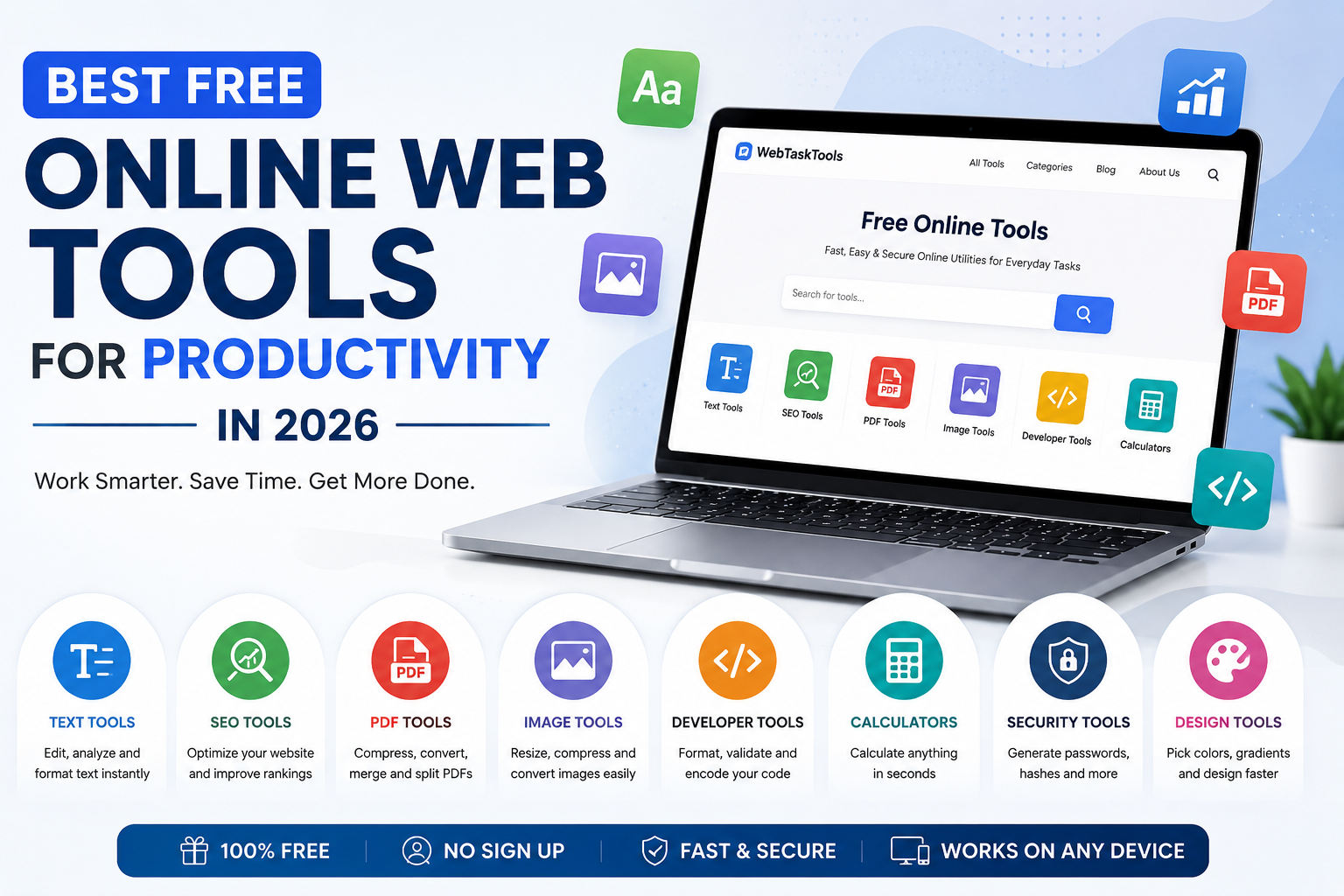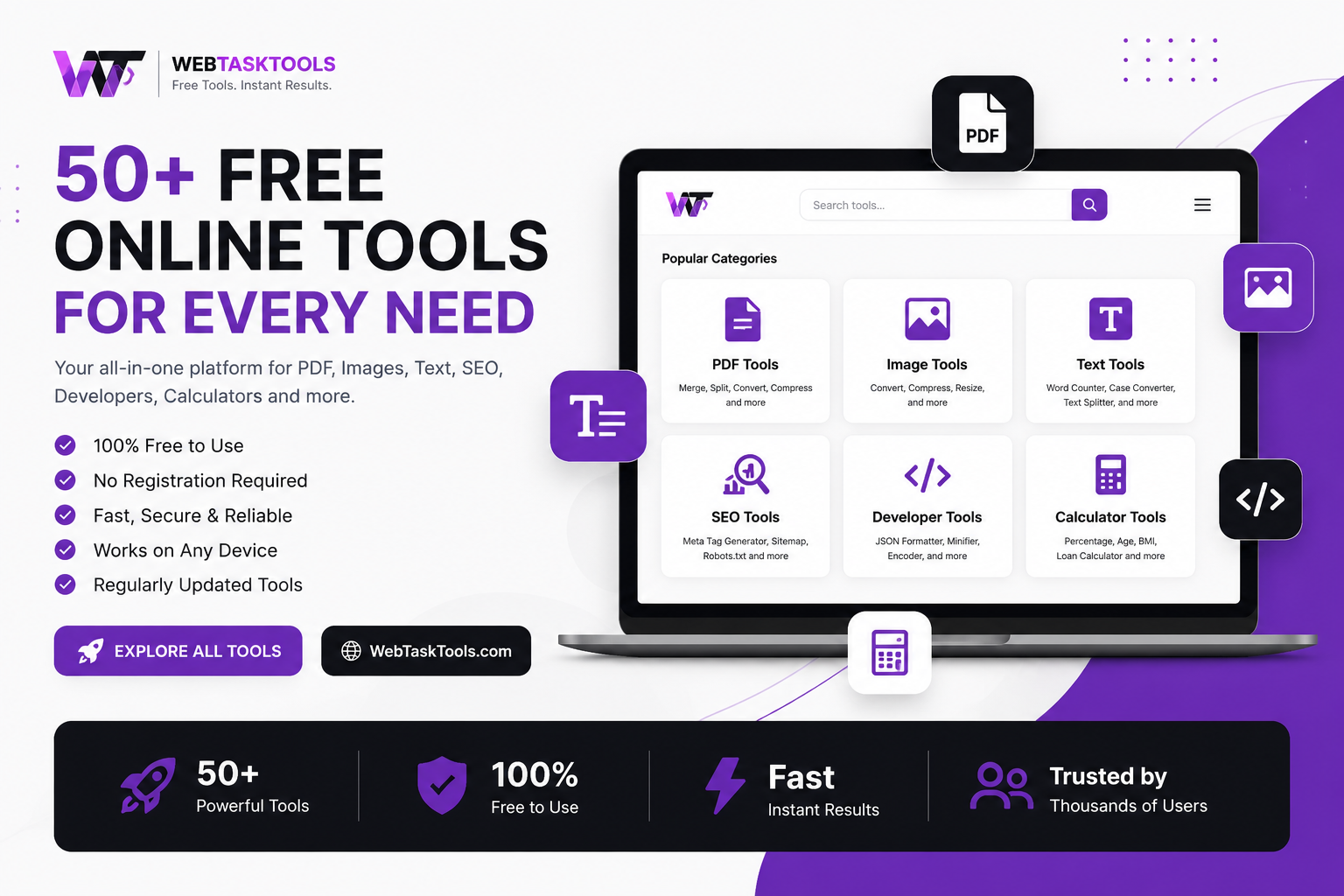
Boost your daily productivity with WebTaskTools. Access thousands of free online tools, text generators, SEO checkers, and converters in one fast dashboard.
In today’s fast-paced digital world, efficiency is everything. Whether you are a developer debugging code, a marketer optimizing a website, or a student formatting an assignment, wasting time switching between dozens of single-purpose websites can heavily slow you down.
Listen instead of read: the free text-to-speech tool turns documents into audio for proofreading on the go.
What if you could access a large collection of free utilities in one single, lightning-fast dashboard without installing heavy software or paying for subscriptions you barely use (subscription prices vary widely by vendor and plan, and the hypothetical $15/month x 6 apps = $90/month math adds up fast even at modest prices)? Welcome to the ultimate hub for productivity: WebTaskTools.
Why You Need an All-in-One Web Toolkit
Most professionals and students have bookmarks cluttered with dozens of separate websites—one for generating passwords, another for converting images, a third for checking meta tags, and a fourth for resizing files. This fragmentation is not only annoying; it's inefficient.
Using an integrated platform changes the game by offering centralized convenience. Here is why consolidating your digital tasks into one platform matters:
- Zero Installation Required: Access everything directly from your browser on any device, whether you are on a desktop, tablet, or smartphone.
- Instant Results: Save valuable minutes with fast, streamlined interfaces built to give you immediate answers.
- Cost-Effective: Get access to powerful utilities without breaking the bank.
Explore the Core Tool Categories on WebTaskTools
To help you accomplish your daily goals faster, our platform categorizes a large collection of tools into intuitive hubs:
1. Checker and SEO Tools
Ensure your website and content are fully optimized. Use our Meta Tags Checker and Website Hosting Checker to audit your web pages, improve search engine visibility, and verify performance metrics in seconds.
2. Developer and Text Utilities
Writing and cleaning code or managing text content has never been easier. Leverage tools like Base64 Encoders/Decoders, Text Separators, HTML Minifiers, and Custom Password Generators to secure your accounts and streamline your code structure.
3. Image and Media Manipulation
Need to process visual assets quickly? Edit, convert, and manage image files on the fly without needing complex software for simple everyday tasks.
4. Advanced Converters
From color codes (HEX to RGBA) and unit measurements to time zones and data sizes, our robust conversion suite handles complex data transformations instantly.
Get Started Today
Stop wasting time searching for scattered utilities across the web. Whether you need a quick QR Code Generator, a text formatter, or advanced development helpers, everything you need is right here.
Visit WebTaskTools today, explore our extensive library, and experience a faster, simpler way to work online!
The Real Cost of Tool Fragmentation
Nobody tracks it, but the cost of scattered tools is paid daily: the password generator bookmarked on the old laptop, the image compressor whose name you forget every time, the PDF site that now demands an account. Each gap is small — thirty seconds here, a frustrated search there — but knowledge workers perform dozens of micro-tasks a day, and the friction compounds. Consolidation is not about the tools being in one place for aesthetic reasons; it is about removing the "where was that thing?" moment from every task.
Building a Personal Productivity Stack
Think in layers. The daily layer is five or fewer tools you could use blindfolded — a text counter, an image compressor, a PDF merger, a password generator. The weekly layer is the next ten: QR codes, JSON validation, SEO checks, unit converters. The occasional layer is everything else, found via category hubs when needed. Most people fail by inverting this: bookmarking forty tools and mastering none. Depth in five beats shallowness in fifty.
Workflows That Actually Save Time
- Morning triage: process every small task (compress that image, check that link, generate that password) immediately in a tab, instead of batching them into an afternoon admin swamp.
- Publish checklist: draft, character count, slug, meta check, compress images, schedule. Same order every time — checklists beat memory.
- Client handoffs: merge deliverables into one PDF, compress it, and send one file instead of seven attachments.
- Security hygiene: unique generated password per account, stored in a password manager. Boring, essential.
Attention Is the Real Productivity Tool
Tools save minutes; attention saves hours. The research on attention residue is clear enough in its practical upshot: every context switch leaves part of your mind behind. Browser-based utilities help here almost by accident — the tool opens in a tab next to your work instead of yanking you into a different application. Pair that with time-boxing (25 focused minutes, then a real break) and single-tasking, and the toolkit stops being a collection of conveniences and becomes part of a system that protects focus.
For Teams: Standardize the Small Stuff
Teams lose surprising time to everyone solving the same micro-problems differently. Agree on one PDF merger, one image compressor, one JSON validator; put the links in the team wiki; onboard new hires with the list. The tools are free, so there is no procurement discussion — just five minutes of agreement that pays off every week in consistent file formats and fewer "how do I...?" messages.
Measuring Your Own Productivity Gains
Do not trust vibes — sample honestly. For one week, note each micro-task and how long it took with your toolkit. Most people discover two things: the toolkit handles far more of the day than they realized, and the remaining slow spots are almost always process problems (unclear requirements, waiting on others), not tool problems. Fix the process; the tools were never the bottleneck.
Common Productivity Traps
- Tool collecting: bookmarking is not using. If a tool has no job this month, it does not need a bookmark.
- Optimizing the rare: perfecting a workflow you run twice a year is procrastination with extra steps.
- Ignoring mobile: test key tools in a mobile browser once, so urgent phone use is never the first test.
- Skipping the verify step: ten seconds checking output beats an embarrassing re-send every time.
Frequently Asked Questions
Can free tools really replace paid software? For quick, occasional jobs — overwhelmingly yes. Heavy sustained work (video editing, professional design) still belongs to dedicated software. Match the tool to the job weight.
How many tools should I actively use? Five daily, ten weekly, the rest on demand. Fewer, mastered, beats many, forgotten.
Is my data safe in browser tools? When a tool processes locally in your browser it has no need to transmit your files — test it yourself: if it works with Wi-Fi off, your data stayed on your device. Prefer those for anything sensitive.
Making New Tools Stick: The Adoption Problem
Everyone has bookmarked a tool and never used it. The fix is implementation intention: decide in advance "when X happens, I will use Y." When I need to share Wi-Fi, I will generate a QR code. When an image goes on the site, it goes through the compressor first. This if-then format works because it outsources the decision to the situation — no willpower required at the moment. Pair each of your five daily tools with its trigger situation this week, and adoption takes care of itself.
Automation: Beyond Single Tools
Browser tools handle single jobs brilliantly; recurring multi-step jobs deserve automation. The ladder: first, a checklist (reliable, free); next, browser bookmarks in a folder you open all at once for a routine; then, for the truly repetitive, simple scripts or automation platforms. Do not automate chaos, though — a messy process automated is just faster mess. Get the manual workflow right with the tools in this guide first; automation comes second.
A Freelancer’s Week With the Stack
Monday: client sends brand assets as seven scattered files — merged into one PDF, compressed, archived. Tuesday: new project kickoff — fresh passwords generated for four accounts, stored in the manager. Wednesday: blog post day — draft checked for length, slug generated, meta tags verified, hero image compressed. Thursday: invoice day — PDF merged, QR payment code added to the footer. Friday: site audit — key pages run through the SEO checkers, one slow page’s images recompressed. None of these moments required software, accounts, or waiting. That is the compounding quiet of a good stack: every week slightly smoother than the last.
Digital Minimalism and Tool Hygiene
There is a paradox: the more tools you collect, the less productive you feel. The antidote is regular pruning — quarterly, open the bookmarks folder and delete anything unused. Unsubscribe from tool newsletters you never read. Close accounts on services replaced by a simple browser utility. Minimalism here is not aesthetic; it is cognitive: every tool you keep is a small ongoing cost in attention, and attention is the budget that matters.
Energy Management Beats Time Management
Here is the uncomfortable truth about productivity advice: it obsesses over minutes while ignoring energy. You will do more deep work in two high-energy morning hours than in six distracted afternoon ones. So schedule the demanding work (writing, debugging, designing) for your peak hours and relegate micro-tasks to the valleys — that is when the toolkit shines, knocking out small jobs with minimal cognitive cost. Protecting energy means real breaks, enough sleep, and single-tasking; no tool compensates for an exhausted brain, but a good toolkit at least stops the small stuff from draining what is left.
Teaching Productivity to Others
The best test of your stack is teaching it: show a colleague the three-click PDF merge, send a friend the password generator with a two-sentence explanation of the manager habit, walk a student through the character counter before essay season. Teaching forces you to simplify, and simplified workflows are the ones that survive contact with busy weeks. Teams that share a toolkit stop losing time to the same small problems twice — the ROI of a five-minute demo is measured in hours per year.
The Two-Minute Rule for Micro-Tasks
David Allen’s famous rule adapts perfectly to web tools: if a micro-task takes under two minutes with the right utility, do it now instead of scheduling it. Compress the image now. Generate the password now. Check the link now. The tasks that pile into overwhelming backlogs are almost never big — they are dozens of two-minute jobs that never got their two minutes. A bookmarked toolkit makes the rule executable: the tool is one click away, so "later" loses its excuse.
Review Rhythms: Weekly, Monthly, Quarterly
Weekly (five minutes): clear the downloads folder, archive finished files, note any recurring friction. Monthly (fifteen minutes): review the toolkit — anything unused gets demoted from the bookmarks bar. Quarterly (thirty minutes): audit the bigger picture — which workflows still feel slow, what new job types appeared, whether any tool added annoying limits. These rhythms are the maintenance schedule for the whole system; skip them and entropy quietly rebuilds the clutter you cleared.
When to Pay for Software (Honestly)
Free browser tools cover the quick and occasional brilliantly — but intellectual honesty requires naming where they stop. Professional video editing, print-grade design, IDE-level development, and batch processing at industrial scale belong to dedicated software, free or paid. The skill is the boundary judgment: if the job takes under ten minutes and involves one file, stay in the browser; if it is an afternoon project with dozens of assets, open the heavy application. Using each where it shines is the actual productivity system — not loyalty to either side.
Start today with the smallest possible version: bookmark five tools, write three checklists, and protect one focused hour tomorrow morning. Systems beat motivation because systems work on bad days too — and most days are, to some degree, bad days. Build the system once, patiently, and it quietly carries you through all of them.
Your First 15 Minutes
Do not finish this article and do nothing. Spend fifteen minutes right now: bookmark the five daily tools, open each one once, and write down your three most common micro-tasks with the matching tool beside each. That tiny setup is the entire difference between readers and doers — and a week from now, reaching for the toolkit will already feel like the obvious move.
Productivity is not a personality trait. It is a small set of tools you trust, a few checklists you follow, and the discipline to protect your attention.