Explore the ultimate guide to free browser-based developer and webmaster tools. Learn how to optimize your workflow with all-in-one online utilities.
The Comprehensive Guide to Essential Browser-Based Developer and Webmaster Tools (2026)
In today's fast-paced digital ecosystem, efficiency is everything. Whether you are a full-stack software engineer writing complex backend logic, a freelance web designer launching a client's landing page, or a digital marketer managing multiple social campaigns, time is your most valuable asset.
Start with the workbench: the developer tools hub gathers every utility below in one place.
Yet, millions of professionals still waste countless hours every single week jumping across random websites just to accomplish basic digital chores. One tab is open for encoding data, another for generating secure passwords, a third for inspecting website hosting, and a separate app is running just to compress an image.
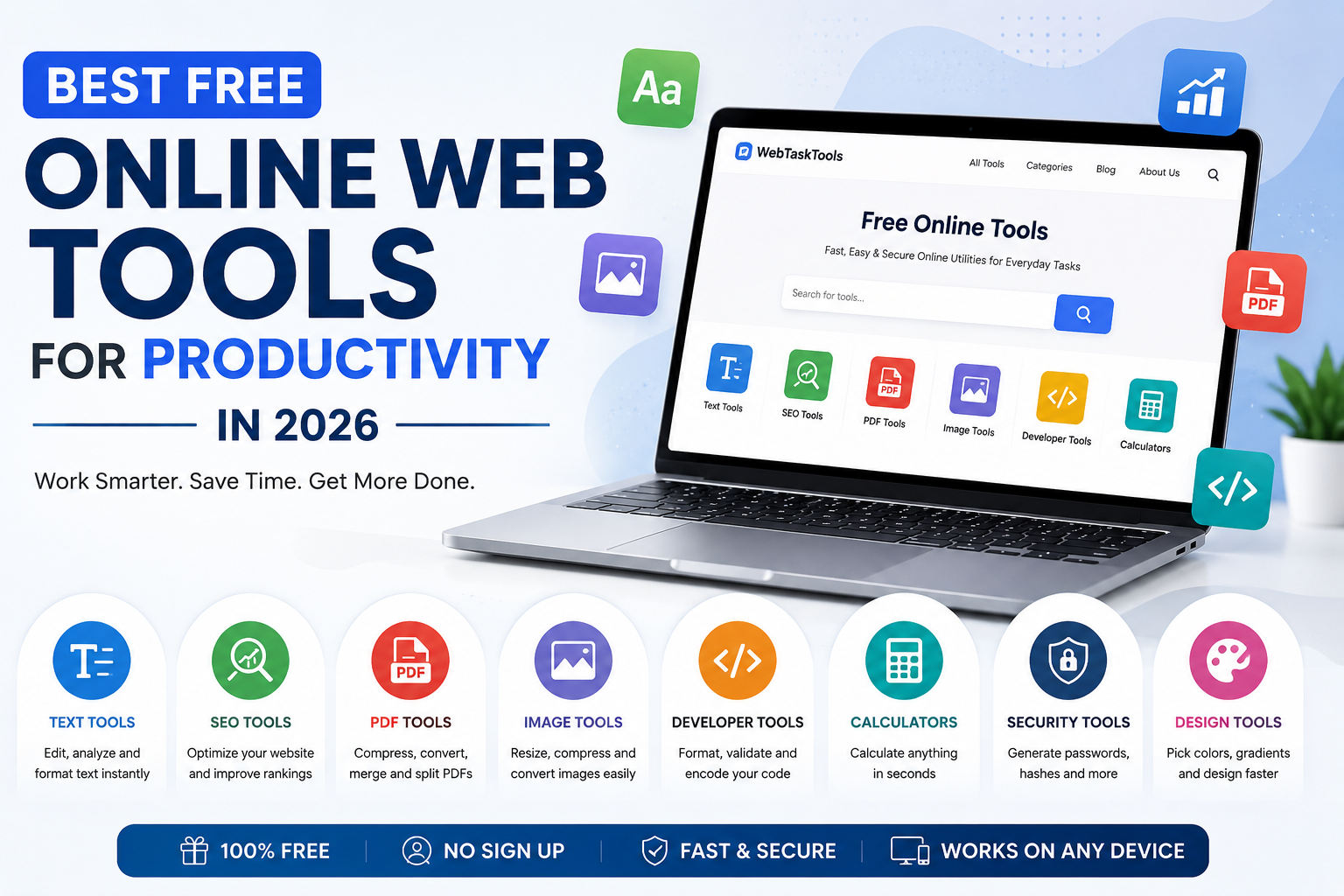
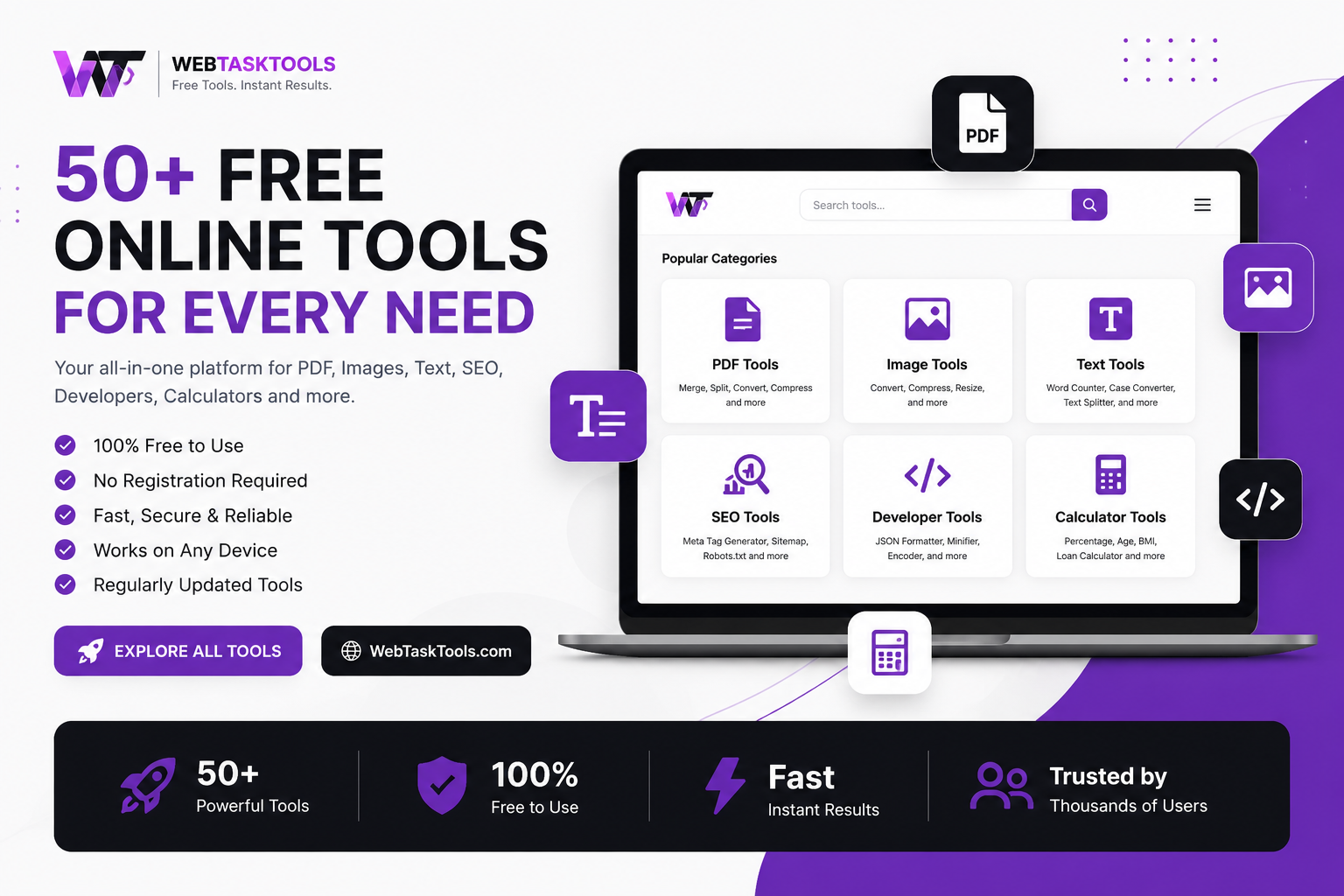
Fragmented workflows kill productivity. What if you could eliminate the clutter, drop the heavy software installations, and access everything you need in a single, lightning-fast dashboard? Welcome to WebTaskTools—your definitive, all-in-one repository for powerful browser-based utilities.
Why Modern Professionals Are Shifting to Browser-Based Utilities
Gone are the days when you needed to install bloated desktop software or complex terminal packages just to perform simple everyday tasks. Browser-based utility platforms have revolutionized how developers and creators handle digital operations for several crucial reasons:
- Zero Friction Setup: Browser tools require no downloads, installations, driver updates, or system configurations. They run instantly inside any standard browser, whether you are on Chrome, Safari, Firefox, or Edge.
- Cross-Platform Compatibility: Because everything runs in the cloud through your browser, you get the exact same high performance whether you are working on a high-end Windows desktop, a Mac, a Linux machine, or even a mobile tablet.
- Resource Efficiency: Heavy software applications hog your RAM and slow down your machine. Lightweight web-based utilities keep your computer running cool and fast while handling heavy data processing seamlessly.
- Instant Accessibility: Need a tool while working from a coffee shop, a client's office, or your home desk? As long as you have internet access, your entire digital toolkit travels with you everywhere.
The Core Pillars of a High-Performance Digital Toolkit
To truly dominate search engine results and provide genuine value that keeps visitors glued to your platform, a website needs to cover every major digital requirement. Here are the core categories that make platforms like WebTaskTools indispensable:
1. Advanced Security and Encryption Utilities
Cybersecurity is no longer optional. Every developer and business owner needs robust defenses against unauthorized access. Creating random, highly complex strings manually is nearly impossible for humans.
- The Solution: Instant password generators that combine upper and lower-case letters, numbers, and specialized symbols at custom lengths to ensure maximum cryptographic strength against brute-force attacks.
2. Data Formatting and Syntax Validation
Data exchange between servers, APIs, and client interfaces relies on clean formatting. A single missing bracket or misplaced quotation mark can crash an entire production environment.
- The Solution: Dedicated JSON formatters, validators, and Base64 encoders/decoders that instantly clean, beautify, and translate raw code blocks without errors.
3. Website Performance & SEO Optimization
Page speed is a primary ranking factor for search engines. Heavy, unoptimized images and poorly configured server parameters will silently kill your organic traffic and convert potential customers away.
- The Solution: Advanced image compressors that shrink file sizes dramatically without sacrificing visual fidelity, alongside website hosting checkers to inspect server infrastructure instantly.
4. Everyday Communication & Marketing Tools
Bridging the physical and digital world efficiently requires quick, scannable mediums for marketing materials, packaging, and digital sharing.
- The Solution: Instant, high-resolution QR code generators that convert URLs, text, and contact cards into scannable vectors in milliseconds.
How to Integrate WebTaskTools Into Your Daily Workflow
Maximizing your output doesn't mean working harder; it means working smarter by streamlining your environment. Here is how you can restructure your daily routine using an all-in-one platform:
- Pin the Hub: Bookmark WebTaskTools directly on your primary browser tab bar for instant, single-click access whenever a task arises.
- Audit Your Tasks: Identify repetitive micro-tasks during your development or marketing cycles—such as cleaning JSON payloads, shrinking marketing assets, or generating secure client keys.
- Execute Instantly: Skip the search engines and navigate straight to the specific tool you need within the platform to get your results in seconds.
Conclusion
The digital landscape rewards speed, precision, and efficiency. Stop letting scattered, ad-heavy, single-purpose websites slow down your projects and frustrate your workflow. By consolidating your development tools, security generators, and optimization utilities into one centralized destination, you free up mental bandwidth to focus on what truly matters: building great things.
Empower your projects, optimize your websites, and supercharge your daily productivity. Visit WebTaskTools today and experience the ultimate standard in free online web utilities!
The Webmaster’s Daily Reality
A webmaster’s day is a mosaic: a DNS record to verify, a meta description to check, an SSL certificate to confirm, a JSON payload to debug, a stylesheet to minify, an image to compress, a redirect to test. None of these is the job — the job is the website working — but all of them guard the job. The professionals who handle this mosaic smoothly share one trait: a organized, trusted set of browser utilities, reached for reflexively, dozens of times a day.
The Essential Toolkit, by Job
Seeing the site (inspection): meta tag checkers, keyword density analyzers, header inspectors — understanding what a page actually presents to search engines and browsers.
Trusting the infrastructure: DNS lookup, hosting checker, SSL checker, blacklist and safety checkers — verifying the foundations before blaming the code.
Handling data: JSON validator and beautifier, Base64 and URL encoders, hash generators, UUID generators — the data plumbing of the modern web.
Shipping lean assets: HTML, CSS, and JS minifiers, image compressor — because every byte shipped is a byte the visitor downloads.
Creating correctly: password generator for credentials, QR code generator for sharing links, slug generator for URLs.
Inspection First: The Diagnostic Habit
The most valuable webmaster habit is also the simplest: when something looks wrong, inspect before assuming. Check what the meta tags actually say (not what the CMS claims). Look up the DNS (not what you remember configuring). Verify the certificate dates. Half of all "mysterious" website problems dissolve under thirty seconds of inspection — because the bug is usually in the configuration, not the code, and inspection reveals configuration instantly.
The Pre-Launch Checklist
- Meta title and description present, honest, and length-appropriate.
- Headings structured: one H1, logical H2/H3 hierarchy.
- Images compressed, sized correctly, with alt text.
- CSS/JS minified; no console errors.
- SSL certificate valid and covering all needed hostnames.
- DNS resolving correctly, including www vs. non-www.
- Forms tested end-to-end (submit, receive, confirm).
- Mobile rendering checked on a real device.
- Analytics and backups confirmed working.
Run this checklist on every launch and every major change. Most production embarrassments are checklist items someone skipped — the list exists because memory is unreliable and launches are stressful.
The Ongoing Health Routine
Websites decay: certificates expire, links break, content drifts, performance regresses. The maintenance routine — monthly for small sites, weekly for busy ones: re-run the inspection tools, check certificate expiry dates, scan for broken links, verify backups restore, review performance. An hour of prevention beats a weekend of emergency repair, every single time. Put it on the calendar; "when I notice" is not a monitoring strategy.
Debugging With the Toolkit: A Method
1. Reproduce — see the problem yourself, in a clean browser session.
2. Inspect — meta, headers, DNS, console: gather facts before theories.
3. Isolate — change one thing at a time; validate data with the JSON tool before blaming code.
4. Verify the fix — re-run the same inspections that found the problem.
5. Document — one line in the runbook, so the next occurrence takes minutes.
This method works because it is boring: facts first, theories later, verification always. The toolkit supplies the facts; discipline supplies the rest.
Security Basics for Webmasters
You do not need to be a security expert, but the basics are non-negotiable: unique strong passwords for every admin account (generated, stored in a manager), two-factor authentication on hosting and CMS, updates applied promptly, backups tested (not just scheduled), and suspicious files or links treated with professional paranoia. Most website compromises exploit the basics — weak passwords, outdated software, untested backups — not exotic zero-days. Cover the fundamentals and you have covered the majority of real risk.
Performance as a Feature
Speed is user experience: compress images before upload, minify assets, lazy-load below-fold content, and keep third-party scripts on a short leash. Measure with real tools, on real devices, on realistic connections — your fiber connection is not your visitor’s connection. Performance work is never finished, but the big wins (images, minification, script discipline) are one-time efforts with permanent returns.
Troubleshooting the Tools Themselves
- Checker shows stale data: DNS and caches propagate; wait, then re-check. Note the check time.
- Validator flags valid-looking JSON: invisible characters (BOM, smart quotes) are the usual culprits — retype the suspicious section.
- Minifier breaks the page: test the minified output before deploying; keep the originals under version control.
- SSL checker disagrees with the browser: check intermediate certificates — the most common real misconfiguration.
Frequently Asked Questions
How many of these tools do I need daily? Five or six cover most days; the rest wait in the hub for their moment.
Can browser tools replace server-side monitoring? No — they complement it. Use both: automated monitoring for alerts, browser tools for diagnosis.
What should I learn first as a new webmaster? The inspection habit: meta checkers, DNS lookup, and the browser’s own developer tools. Diagnosis before everything.
The website works because someone checks. Be the someone — with the right tabs open.
The Runbook: Your Future Self Will Thank You
Every site deserves a runbook: hosting login location, DNS provider, backup schedule and restore procedure, certificate expiry dates, the pre-launch checklist customized for this site, and "when X happens, do Y" for the three most common incidents. One page, updated when things change. The runbook turns 2 AM emergencies into procedures — and turns your eventual successor (or future-you, having forgotten everything) into a competent operator within minutes.
Communicating With Clients and Stakeholders
Webmasters translate: "the DNS TTL is 3600" becomes "changes take up to an hour to show everywhere." Learn to report in outcomes, not mechanisms — stakeholders care that the site is fast and safe, not which checker verified it. When incidents happen, communicate early with what you know, what you are doing, and when the next update comes. Calm, factual updates build more trust than fast, chaotic fixes.
The Learning Path
New webmasters: start with inspection (meta, DNS, browser dev tools), then data handling (JSON, encoding), then asset optimization (minification, compression), then infrastructure (SSL, hosting, backups). Each layer builds on the last, and the browser toolkit supports every step — the same tabs you use on day one are the ones you use in year ten. Mastery is not more tools; it is deeper judgment with the same tools.
Automate What Repeats, Tool What Varies
The final maturity: anything that happens on a schedule gets automated (backups, certificate renewal, uptime checks, report generation); anything that varies gets the browser toolkit (diagnosis, one-off checks, client questions). Automation handles the predictable; the toolkit handles the surprising. Together they cover the whole job — and the webmaster’s time goes where judgment matters, not where repetition lives.
The Webmaster’s Creed
Inspect before assuming. Checklists over memory. Backups tested, not just scheduled. Facts first, theories later. Small tools, used reflexively, beat big tools used rarely. The website works because someone checks — and now that someone is you, with every utility one click away.
Open the developer tools hub, pin your five, and run the health routine on your most important site this week. Future-you — calm during the next incident, because the runbook exists and the tabs are ready — says thanks.
Appendix: The Essential Five (Pin These)
Meta Tags Checker — see what search engines see. JSON Validator & Beautifier — debug every payload. DNS Lookup — verify the foundations. Image Compressor — ship lean pages. Password Generator — secure every account. Five pinned tabs, and the mosaic of webmaster tasks becomes a calm, checkable routine.