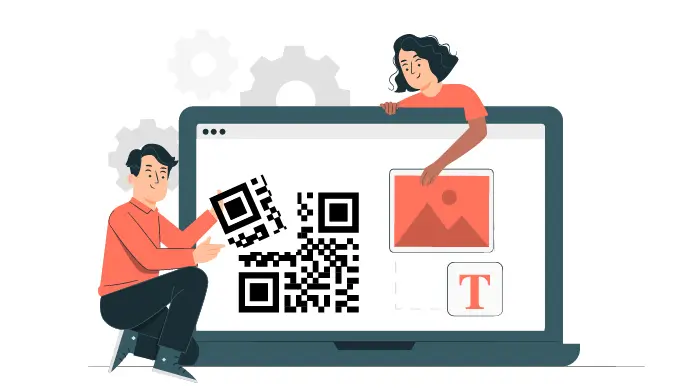
Generate custom QR codes online for free for business, menus, and social media.
QR codes have become an essential part of our daily lives. From restaurant menus and business cards to Wi-Fi sharing and social media links, people scan QR codes everywhere. But when you need to generate one quickly, running into paid software or sites with hidden fees can be frustrating.
Create yours now: the free QR code generator makes a scannable code in seconds.
What if you could create professional, high-quality QR codes in seconds without spending a dime? Welcome to the easiest way to generate codes on the fly with WebTaskTools.
Why QR Codes Are Essential for Everyone
Whether you run a small local business, manage a digital brand, or just want a fast way to share information, QR codes bridge the gap between physical and digital worlds seamlessly. Here is why you should use them:
- Instant Access: Users don't need to type long URLs; a simple smartphone camera scan does the job instantly.
- Versatility: You can encode website links, contact details, text, and much more.
- Professional Look: Cleanly generated codes enhance your marketing materials, flyers, and business cards.
How to Generate a QR Code in Seconds
Creating a custom QR code doesn't require technical skills. Follow these simple steps:
- Head over to WebTaskTools.
- Select the QR Code Generator tool.
- Paste your link, text, or data into the input field.
- Generate and download your custom QR code instantly!
Conclusion
Stop wasting time with complicated software or limited free trials. For all your daily digital needs—ranging from quick code generation to file conversion and SEO checks—WebTaskTools has you covered.
Visit our platform today and explore thousands of free utilities designed to make your life easier!
What You Can Encode in a QR Code
- Website URLs — the classic: menus, landing pages, portfolios, event pages.
- Wi-Fi credentials — guests join the network by scanning; no more dictated passwords.
- Contact cards (vCard) — scanning adds you straight to the phone’s contacts.
- Plain text — instructions, serial numbers, short messages.
- App links, maps locations, payment pages — anything reachable by URL or text.
Size, Distance, and Scannability
A QR code is a physical object with physics. The rule of thumb: the code should be at least 2 x 2 cm for hand-held scanning, and scale up with viewing distance — a poster across the room needs a much bigger code than a business card. Print contrast matters more than screen contrast: dark on light, matte over glossy (glare kills scans), and always keep the quiet zone — the clear border around the code — free of design elements. Dense codes (very long URLs) are harder to scan than sparse ones, so shorten URLs before encoding.
Error Correction: Why Damaged Codes Still Work
QR codes include built-in error correction — redundant data that lets scanners reconstruct the message even if part of the code is obscured or damaged. Higher error correction survives more damage but makes the code denser. For codes that will live rough lives (outdoor signage, equipment labels, packaging), the tradeoff favors robustness; for pristine print (business cards, screens), density matters less. Either way, test with a smudged printout before committing to 5,000 copies.
Design Tips That Do Not Break Scanning
- Contrast first, style second: inverted or low-contrast designer codes fail in real lighting.
- Add a call to action: "Scan for the menu" dramatically outperforms a lonely code.
- Brand the frame, not the code: put logos and colors around the quiet zone, never inside the pattern.
- Test on real phones: at least two devices, at the intended distance, in the intended light.
QR Code Security Essentials
Because people cannot read QR codes with their eyes, attackers abuse them — stickers over legitimate codes, malicious codes in emails. Build the habit: check the URL preview your camera shows before opening, be wary of codes in surprising places, and never enter passwords after scanning something you did not already trust. For codes you publish, own the destination URL so it cannot be hijacked later.
Measuring Whether Your Codes Work
Static QR codes are private by design — nobody tracks scans. If you need analytics, point the code at a URL you control and measure visits in your normal analytics. That gives you the data without depending on a third-party QR service that might paywall your links later. Compare scan-driven visits against the effort of placement, and you will quickly learn which locations earn their print cost.
Troubleshooting
- Will not scan: move closer, kill glare, or reprint larger.
- Scans but goes nowhere: the destination URL is wrong, moved, or offline — verify it in a browser.
- Too dense: shorten the URL and regenerate.
- Old phone struggles: some older devices need a dedicated scanner app.
Frequently Asked Questions
Do QR codes expire? Static codes never expire — the data lives in the pattern itself.
Can I use them for business? Yes. The QR standard is free to use, and self-generated codes carry no licensing burden.
What is the best format to download? PNG works for most print and screen uses; keep a high-resolution master for reprints.
QR Codes in Marketing Campaigns
Marketers love QR codes for one reason: they connect offline attention to online action measurably. A flyer with a QR code to a landing page turns "we printed 2,000 flyers" into "412 people scanned, 89 signed up." The discipline: one code, one destination, one call to action per campaign — never a code to a homepage. Use unique landing URLs per placement (flyer vs. poster vs. receipt) so analytics reveal which physical locations actually perform. And always include the short URL in text beneath the code for the small fraction of phones that cannot scan.
Restaurants: Beyond the Menu
Menus were just the start. The full restaurant playbook: table-tent codes for ordering and payment, a code on the receipt linking to a review page (timed when satisfaction peaks), Wi-Fi codes on every table, and a code on the storefront for after-hours menu browsing. The common thread is removing waiting — for menus, for bills, for the check. Each removed wait is a better review and a faster table turnover, which is why QR adoption stuck in hospitality long after the novelty faded.
Events: The Attendee Journey
Walk the attendee journey and place codes at every friction point: the invitation links to registration, the confirmation email carries a ticket code, venue signage points to the schedule and maps, session slides link to feedback forms and slide downloads, and the farewell email requests testimonials while the experience is fresh. Organizers who do this well collect dramatically more feedback and content than those relying on "visit our website" announcements nobody acts on.
Education: Classrooms and Campuses
Teachers use QR codes as physical hyperlinks: worksheet headers linking to video explanations, classroom walls linking to assignment portals, textbooks linking to updated resources, library displays linking to catalogs. The pedagogy is sound — it meets students where their attention already is (the phone) and routes it somewhere useful. For campuses, wayfinding codes on signage help new students navigate without an app install.
Real Estate and Local Business
A signboard QR code linking to the listing means every passerby at midnight is a potential viewing — the property markets itself around the clock. Add a virtual tour link, a mortgage calculator page, and the agent’s contact card, and the sign becomes a salesperson. For local shops, the same pattern: window codes for after-hours browsing, product tags linking to reviews and manuals, receipts linking to loyalty signup. Small businesses get enterprise-grade bridging for the price of printing.
Payments and Transactions
In many regions QR payments are everyday infrastructure: scan, confirm, done — no card numbers exchanged, no terminals needed. Even where QR payments are less common, codes linking to payment pages on invoices get bills paid faster than "mail a check" or "log in to our portal." The principle: every step removed between the bill and the payment is money collected sooner. Always verify payment codes point to your genuine payment provider — sticker-swap scams target exactly this.
Networking: The Digital Business Card
The vCard QR code is the single highest-ROI personal use: one scan adds your name, number, email, and company to someone’s contacts — no typing, no lost cards, no "sorry, what was your email again?" Put it on your phone’s lock screen or wallpaper for conferences, on the back of physical cards as backup, and in your email signature for good measure. The people who network most effectively are simply the easiest to follow up with.
Packaging, Labels, and the Physical Web
Product packaging is prime QR real estate: manuals (nobody keeps paper manuals), warranty registration, how-to videos, ingredient sourcing stories, reorder links. Industrial labels carry serial numbers and maintenance logs; museum placards link to deep dives; trail markers link to maps. Anywhere a physical object has more to say than fits on its surface, a QR code is the right bridge — permanent, free, and requiring no app on the visitor’s side.
Accessibility and Inclusivity
QR codes exclude nobody by design — but only if deployed thoughtfully. Always pair the code with a short text URL for people whose cameras cannot scan; keep the destination page itself accessible and mobile-friendly; and never make the QR code the only path to something essential (there is always someone with a dead battery). For low-vision users, large high-contrast codes with clear labels work best. Inclusivity here costs nothing extra — it is just remembering that the code serves people, not the other way around.
QR Codes and Privacy
A privacy note for both creators and scanners. Creators: static codes you generate yourself phone home to nobody — the scan goes straight to your URL. That is the privacy-preserving choice; "free dynamic QR" services interpose themselves and see every scan. Scanners: a QR code can encode any URL, including tracking-laden or malicious ones — preview before opening, especially for codes in public places. The technology is neutral; the privacy outcome depends on who stands between the code and the destination.
Future-Proofing Your Codes
Codes you print today may outlive campaigns, roles, and even businesses. Future-proof them: encode URLs on domains you control for the long term, keep a redirect map so destinations can move without reprinting, save the source data for every printed code, and prefer your own short links over third-party shorteners that might vanish. A code printed on a building sign is a ten-year commitment — treat the URL behind it accordingly.
Your First QR Code: A 5-Minute Walkthrough
Minute one: decide the destination — the exact page, not the homepage. Minute two: shorten the URL if it is long. Minute three: paste it into the QR generator and create the code. Minute four: download the high-resolution version and scan it with your phone to verify. Minute five: place it with a clear call to action and the short URL printed beneath. Five minutes, and you have joined the ranks of people whose physical world links gracefully to their digital one.
Common Objections, Answered
"Nobody scans QR codes." Scan rates vary enormously by context — a code with a clear call to action in a moment of need (menu, Wi-Fi, ticket) gets scanned; a lonely code on a cluttered poster does not. The variable is execution, not the technology.
"They look ugly." Only when designed as an afterthought. Framed well, with branding around the quiet zone, codes look intentional.
"People do not know how." Every modern smartphone camera scans natively; the knowledge gap closed years ago.
"What if the link dies?" Own the destination URL and keep redirects — a solved problem, not a reason to avoid codes.
The pattern across every industry in this guide is identical: find the moment of friction, place a code with a clear reason to scan, own the destination, and test before printing. Master that loop and QR codes stop being a novelty and become what they were always meant to be — the shortest path between intention and action.
The best QR code is invisible infrastructure: scanned in a second, forgotten immediately, job done.