Discover how using free online web tools, image compressors, and developer utilities can save time and supercharge your everyday productivity without installing software.
In today's fast-paced digital world, time is our most valuable asset. Whether you are a student, a developer, a content creator, or a digital marketer, everyday tasks often involve minor digital hurdles: converting an image format, compressing a heavy PDF, validating code, or generating secure passwords.
Secure every new account in seconds with the free password generator.
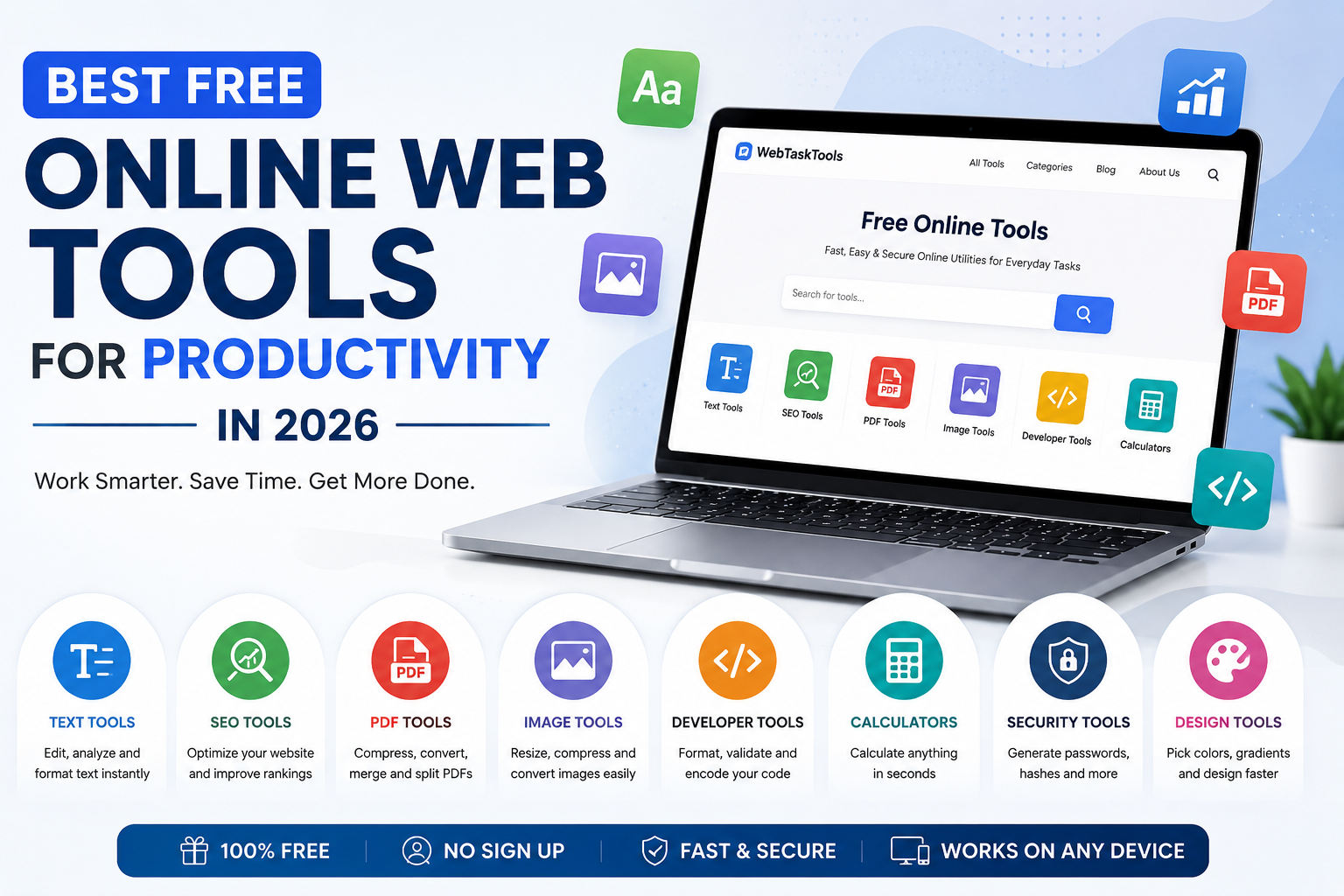
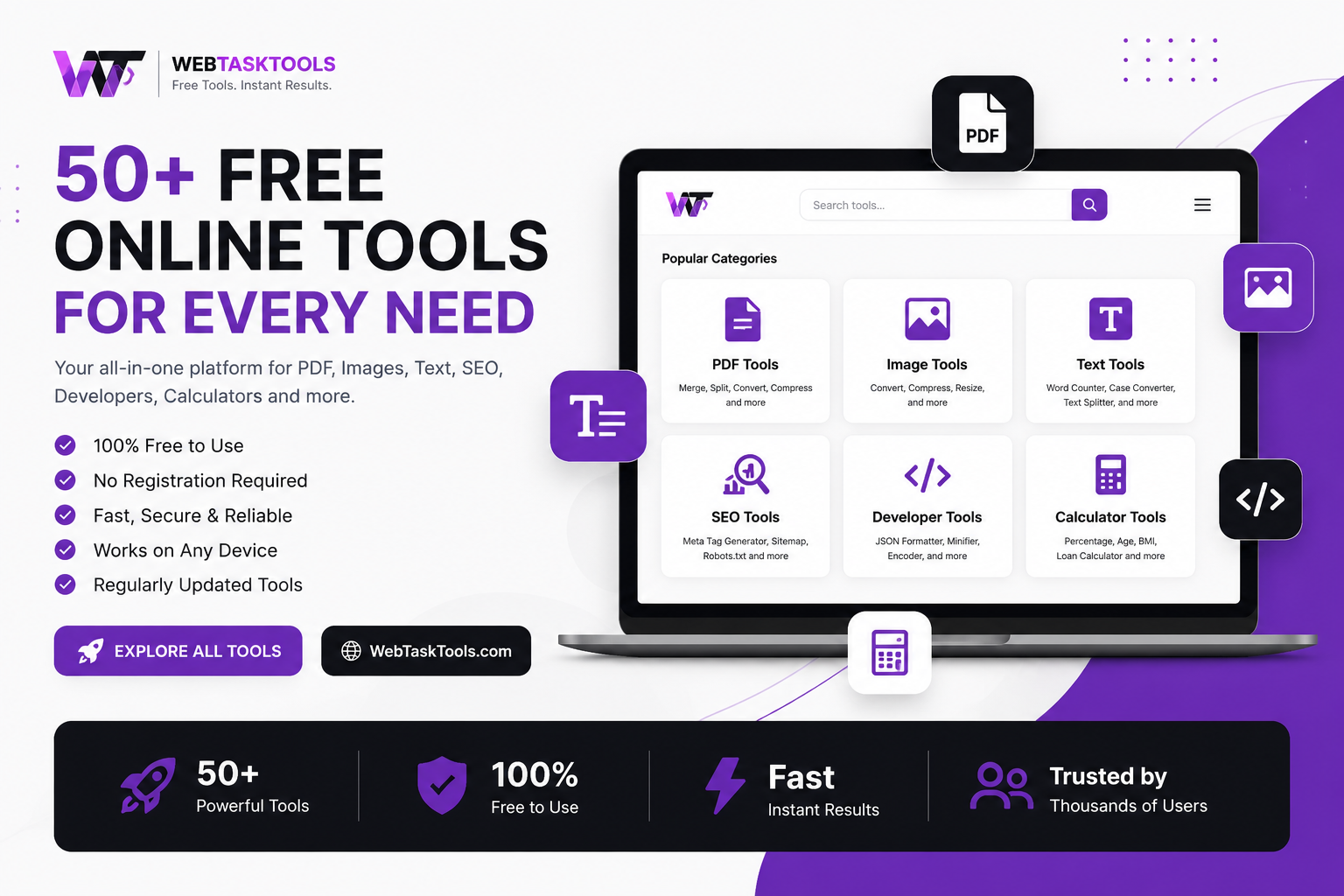
In the past, solving these small problems meant downloading heavy software or buying expensive licenses. Today, platforms like WebTaskTools have completely changed the game by offering thousands of free, browser-based utilities.
Here is why utilizing free online web tools can completely transform your daily workflow.
1. Zero Installation, Instant Access
One of the biggest advantages of online tools is convenience. You don’t need to worry about system compatibility, storage space, or lengthy installation processes. Whether you are on a Windows PC, a Mac, or a smartphone, you can access tools instantly right inside your browser.
2. Save Time on Repetitive Tasks
Small delays add up. Waiting for heavy desktop applications to open just to resize an image or format a piece of JSON text can drain your focus. Online utility suites bring everything under one roof—from text editors and format converters to developer tools—allowing you to finish tasks in seconds instead of minutes.
3. Cost-Effective Solutions
Why pay for expensive software suites when you can perform everyday tasks for free? Platforms providing free online generators, text tools, and image compressors make professional-grade utilities accessible to everyone without hitting a paywall.
4. Privacy and Ease of Use
Modern web tools are designed with user experience and privacy in mind. Many utility tools process tasks smoothly and securely within your browser environment, keeping your workflow fast, clean, and straightforward.
Final Thoughts
Efficiency isn't about working harder; it's about working smarter. By keeping a reliable toolkit of free online web utilities bookmarked, you eliminate unnecessary digital friction and free up mental energy for the things that truly matter.
Explore the massive library of free tools available on WebTaskTools today and see how much faster your daily workflow can be!
The Compound Effect of Small Wins
Nobody writes a case study about saving ninety seconds. But knowledge work is hundreds of ninety-second tasks: checking a character count, compressing an image, validating JSON, generating a password, merging a PDF. Shave friction off each one and the workday quietly reorganizes itself — not through heroic effort, but through the compound effect of small wins. The people who seem "fast" usually are not working harder; they have simply removed the tiny delays everyone else tolerates.
Why Browser Tools Beat Installed Software for Micro-Tasks
- Zero startup cost: a tab opens instantly; an application launches, updates, and demands attention.
- No installation: nothing to download, no admin rights, no disk space, no update nagging.
- Available everywhere: the office desktop, the home laptop, the library computer — the toolkit follows the browser.
- Single-purpose clarity: one job, one interface, no feature maze to navigate.
- Free for the occasional: installing paid software for a monthly two-minute job never made sense.
The Psychology: Lowering Activation Energy
Every task has activation energy — the effort to begin. High activation energy means procrastination: the PDF that needs merging sits for a week because "setting up the software" feels like a project. Browser tools collapse activation energy to near zero: click, do, done. Tasks that took "someday" take "now." This is the underappreciated productivity mechanism — not speed, but willingness. The fastest tool is the one you will actually open.
Attention Residue and Context Switching
Switching applications carries a cognitive cost: part of your attention stays stuck on the previous context. Researchers call this attention residue, and while exact recovery times vary by person and task, the practical advice is uncontroversial — fewer switches mean deeper focus. Browser tools help structurally: the utility opens beside your work instead of replacing it, so the context switch is shallow. You never really "leave" — you glance, act, and return.
Building the Two-Minute Habit
The rule: if a micro-task takes under two minutes with the right tool, do it immediately. Compress the image now. Generate the password now. Check the link now. Backlogs are rarely built from big tasks — they are dozens of two-minute jobs that never got their two minutes. A bookmarked toolkit makes the rule executable because the tool is always one click away; "later" loses its excuse.
Measuring What Matters
Do not measure "hours saved" — measure friction removed. For one week, notice each moment of tool friction: the hunt for a bookmark, the signup wall, the confusing interface. Each one is a candidate for replacement. People who do this audit typically find a handful of recurring annoyances; fixing those few changes the texture of every workday. The goal was never a number — it is the feeling of work flowing instead of stalling.
For Teams: Multiplying the Effect
One person with a toolkit is efficient; a team with a shared toolkit is something more. Standardize the small stuff — which PDF merger, which compressor, which JSON validator — and put the links in the team wiki. New hires onboard faster, file formats stay consistent, and the "how do I shrink this PDF?" messages stop. The tools are free, so adoption costs nothing but five minutes of agreement.
Common Objections
"Free tools cannot be good." For single-purpose utilities, free and excellent coexist happily — the economics of web tools allow it.
"I already have software for that." If opening it takes longer than the job, you effectively do not.
"It is only a minute." A minute, fifty times a week, across a team of ten, is a different conversation.
"What about privacy?" Prefer tools that process in your browser — if it works offline after loading, your data never left your device.
Frequently Asked Questions
How many tools should I use? Five daily, ten weekly, the rest on demand. Depth beats breadth.
Do browser tools work on phones? Yes — test your key tools in a mobile browser once so urgent mobile use is never the first test.
Can they replace my professional software? For quick jobs, yes; for heavy sustained work (video editing, design), dedicated software still wins. Match the tool to the job.
Productivity is not about speed. It is about removing every reason not to start.
A Day in the Life: With and Without the Toolkit
Without: 9:00 — need to check a headline length; Google "character counter," pick a random site, close three popups. 11:30 — client image is 6 MB; open heavy photo software, wait, export, guess at settings. 2:00 — PDF needs two pages extracted; email a colleague who "has the software." 4:30 — new account needs a password; reuse a variation of the old one. With: each of those is a bookmarked tab and under a minute. Same tasks, same person — the difference is purely infrastructure. Nobody gets a promotion for compressing images faster; but the hours quietly returned to deep work are where promotions actually come from.
The Economics Nobody Calculates
Consider the fully-loaded cost of "free with friction": a professional losing fifteen minutes daily to tool friction loses over sixty hours a year — more than a work week — to popups, signups, and software launches. Against that, a curated bookmark folder costs thirty minutes to build and nothing to maintain. No finance department would approve the first arrangement if it were presented as a budget line; it persists only because it is invisible. Make it visible, fix it once, and keep the week.
Digital Minimalism for Tool Users
Ironically, productivity tooling can become its own clutter: forty bookmarks, twelve "productivity" apps, three note systems. The minimalist correction: one bookmark folder, reviewed quarterly; tools earn their place by monthly use or leave. Unsubscribe from tool newsletters unread. The goal is fewer, better, faster — a toolkit so lean you could rebuild it from memory. Lightness is a feature: every tool you keep is a small tax on attention, and attention is the actual budget.
Energy Management: The Other Half
Time management obsesses over minutes; energy management wins days. Schedule demanding work for peak-energy hours and relegate micro-tasks to the valleys — that is when the toolkit shines, dispatching small jobs at minimal cognitive cost. Protect the peaks ruthlessly: notifications off, single-tasking, real breaks. No tool compensates for exhaustion, but a frictionless toolkit at least stops the small stuff from draining what is left.
Teaching the Toolkit
The fastest way to lock in these habits is teaching them: demo the three-click PDF split to a colleague, send a friend the password generator with a two-sentence explanation, walk a student through the character counter before essay season. Every explanation simplifies your own workflow — and teams that share a toolkit stop losing time to the same small problems twice.
The Quarterly Review (15 Minutes)
Every three months: open the bookmarks folder, remove what went unused, check whether any tool added annoying limits or account demands, and browse the category hubs for new arrivals matching new job types. Fifteen minutes, four times a year, keeps the toolkit sharp indefinitely. Systems decay without maintenance; this is the entire maintenance schedule.
Starting Today: The 15-Minute Setup
Minutes 0-5: bookmark five tools — a character counter, an image compressor, a PDF merger, a password generator, a QR code generator. Minutes 5-10: run one real task through each, so the first urgent use is never the first test. Minutes 10-15: write your three most common micro-tasks on a sticky note with the matching tool beside each. That is the whole setup. In a week, reaching for the toolkit will feel obvious; in a month, you will wonder how you worked without it.
The Long Game
Tools will change — new ones appear, old ones add limits, formats evolve. What does not change is the underlying skill: noticing friction, reaching for the lightest adequate tool, and keeping the toolkit pruned. Build that meta-skill now and every future tool slots into a system that already works. The specific bookmarks are almost incidental; the habit of frictionless work is the actual asset, and it compounds for a career.
What "Boosting Productivity" Actually Looks Like
Forget the motivational posters. Real productivity gains look boring: the same Tuesday as last Tuesday, minus eleven small annoyances. The report finished before lunch because the images were already compressed. The client email sent in one draft because the character count was checked inline. The deploy unblocked in minutes because the JSON validated on the first paste. Nothing dramatic happened — and that is exactly the point. Dramatic rescues mean the system failed; quiet Tuesdays mean it is working.
The Myth of the Perfect Setup
There is no perfect toolkit, only a toolkit that fits your actual work. A developer’s five daily tools differ from a marketer’s, which differ from a student’s. Resist copying someone else’s list wholesale — start from the starter five in this guide, then let real jobs vote new tools in and disuse vote old tools out. Your toolkit should look like a record of your work, because that is what it is: the fossil record of problems you actually solved.
One Final Reframe
Stop asking "how do I do more?" and start asking "what is slowing me down?" The first question leads to longer hours; the second leads to a better toolkit. Every friction you remove stays removed — it pays you back daily, quietly, for years. That is the whole philosophy in one sentence, and it is worth more than any list of tools: productivity is subtraction, not addition.
Bookmark the five starter tools before you close this tab. Your future Tuesdays will thank you — quietly, without drama, exactly as productivity should.
The toolkit is ready. The only remaining step is the smallest one: open the first tab.
Appendix: The Starter Five (Bookmark These)
Character Counter — every writing task with a limit. Image Compressor — every image bound for the web. Merge PDF — every document assembly job. Password Generator — every new account. QR Code Generator — every link shared offline. Five bookmarks, and roughly eighty percent of micro-task friction disappears within a week.